


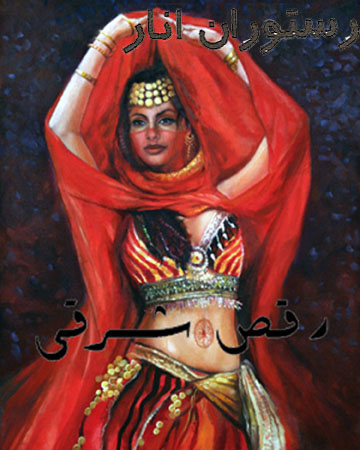
ベリーダンスは中東およびその他のアラブ文化圏で発展したダンス・スタイルを指す言葉であり、これらを呼称するために造語された西洋の呼称である。
アラブ文化圏ではラクス・シャルキー(Raqs Sharqi رقص شرقي、「東方の踊り」の意)、ラクス・バラディー(Raqs Baladi رقص بلدي 「民族舞踏」の意)として知られ、トルコ語ではオルヤンタル・ダンス(Oryantal dansı、「東方舞踏」の意)として知られている。特に「ラクス・シャルキー」と言う言葉の起源はエジプトであるとされる。
ヨーロッパでも「オリエンタル・ダンス」「ダンス・オリエンタル」「エキゾチック・オリエンタルダンス」「オリエンタル・ベリーダンス」などの呼び名で知られ、アメリカ人の熱狂的なファンの中には単に「中東の踊り」と言えばこのベリーダンスであると述べる者もいる。
ベリーダンスはイスラム時代以前のエジプトより、口承に基づき伝授され知られてきた。その起源は諸説存在するが、地中海世界、中東、アフリカと関係がある という証拠が最も多く挙げられている。例えば紀元前5世紀ほど昔のものといわれるエジプトの墓の壁画には、半裸のダンサー達が描かれており、その姿はベ リーダンサーが鏡の前で行う柔軟体操の姿勢に似ている。また、12世紀から13世紀にかけてのペルシャの細密画の中においてもベリーダンスの描写が見ら れ、その歴史の長さを伺わせる。
中東以外の地域においては、18世紀から19世紀に掛けて勃興したロマン主義運動の高まりの中で、オリエンタリズムの芸術家達がオスマン帝国のハレムの生活を解釈して描いた絵画のなかに登場したことにより、一般的に知られるに至った。
ウズベキスタンダンスとは?
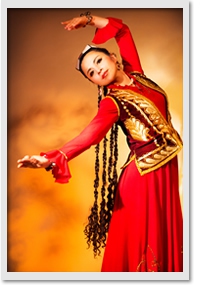 シルクロードの中心として栄え、現在も数々の美しい建築物が残るウズベキスタン共和国。
この国の魅力を語る上で欠かせないのが、壮大なイスラム建築、そして民族舞踊です。
胡旋舞とも呼ばれるこの舞踊は、何度も高速で回転するのが特徴であり、中国の古書には「胡姫の女康居(サマルカンド)に出ず」等、白居易や李白、白楽天などの詩人や多くの英雄たちを魅了し唐の長安の夜を彩った様子が伝えられています。
このシルクロード全域に伝わる「胡旋舞」とは文字通り何度も回転する女性の踊りで、誘惑の踊りであると同時に絹の製造法や刺繍の様子を表した踊りも伝承されています。
ウズベキスタンの民族舞踊は、現在も人々の生活を切り離す事はできません。祭や結婚式などでは必ず踊られます。
ウズベキスタンの民族舞踊は胡旋舞とも呼ばれ、その名のとおり身体を激しく回転させるのが特徴です。様々な意味を持つ腕や手の動きや、身体を後ろに反らせる動き、肩の揺れ活発な顔の表現がシルクロードを訪れる人々を魅了します。
フェルガナ、ブハラ、ホレズムという三つの地方が有名で、フェルガナ舞踊は最も叙情的であり柔軟な手の動きが特色です。ホレズム舞踊は、胴体・手を震わせ、頻繁な頭の動きとコミカル要素が特色です。そしてブハラ舞踊は歯切れがよい動きと速い回転が特色です。
歌舞団で用いられる楽器では、ドイラと呼ばれる打楽器は欠かすことができません。その他、タンブールtanbur、ドタールdutor、ギジャク ghidjak、カシュガル・ルボーブKashgar rubobなどの弦鳴楽器や横笛のナイnai など、異国情緒溢れるメロディーを生み出す民族楽器があります。
About a belly dance?
A belly dance is a word which points out the dance style developed in the Middle East and other Arab cultural spheres, and is the name of the West coined in order to call these.
In the Arab cultural sphere, it is lax シャルキー (Raqs Sharqi.).
????, mind of “an east dance”, lax Varaday (Raqs Baladi.)
????
It is known as mind of a “race dance” and is known for Turkish as an Orr Jan Tal dance (Oryantal dans?, mind of an “east dance”).
It is supposed that it is Egypt especially the origin of the language called “lax シャルキー.”
It is known for names, such as “oriental dance”, “dance oriental”, “exotic oriental dance”, and an “oriental belly dance”, even in Europe, If it is only called “an Middle Eastern dance”, there are also those who say that it is this belly dance among enthusiastic American fans.
From Egypt before its Islamic days, a belly dance is taught and known based on an oral tradition.
Although the origin recognizes various-views existence, it is related to the Mediterranean world, the Middle East, and Africa. Most proof to say is mentioned.
For example, the dancers of half-nakedness are drawn on the mural painting of the grave of Egypt which will be called old thing as for about the century [ 5th ] B.C., and the figure is ベ. リーダンサー resembles the posture of the calisthenics performed in front of a mirror.
Moreover, depiction of a belly dance is [ be / it / under / of the miniature of Persia from the 12th century to the 13th century / also setting ] 見ら. It is made to hear about the length of れ and its history.
In areas other than the Middle East, it generally came to be known by having appeared into the pictures in which the artists of orientalism interpreted and drew the life of the harem of Ottoman Empire in the rise of Romantic Movement which rose from the 18th century to the 19th century.
About the Uzbekistan dance?
Republic of Uzbekistan where it prospers as a center of the Silk Road, and many beautiful buildings remain still now.
When telling the charm of this country, grand Islamic construction and race dancing are indispensable.
Signs that it is the feature that this dancing called 胡旋舞 rotates repeatedly at high speed, it charmed poets, such as Bai Juyi, Li Po and Pai Lo-tien, and many heroes, such as “not appearing in 女康居 (Samarkand) of 胡姫”, to the Chinese old book, and it colored the night of Changan of Tang are told.
While this “胡旋舞” transmitted throughout the Silk Road is a dance of the woman who rotates literally repeatedly and it is a dance of temptation, the dance showing the manufacturing process of silk or the situation of embroidery is also handed down.
The race dancing of Uzbekistan cannot separate people’s life still now.
At a festival or a marriage ceremony, it certainly dances.
It is the feature for race dancing of Uzbekistan to also be called 胡旋舞 and to rotate the body violently as the name suggests.
A motion of an arm and a hand with various meanings and people that bend themselves backward back and to whom it moves, the shoulder shakes and expression of an active face visits the Silk Road are charmed.
A motion of a hand three districts called Fergana, Bukhara, and Khorezm are famous, and most lyrical [ Fergana dancing ] and flexible is the special feature.
Khorezm dancing shakes the body and a hand and a motion and comical element of the frequent head are the special feature.
And a motion crisp [ Bukhara dancing ] and quick rotation are the special features.
By the musical instrument used in an utamai team, it is [ the percussion instrument called ドイラ ] indispensable.
In addition, 弦鳴 musical instruments, such as Tambour tanbur, ドタール dutor, ギジャク ghidjak, and Kashgar ルボーブ Kashgar rubob, Nay nai of a fife, etc. have folk instruments which produce the melody which is full of an exotic mood.
